2026-09-14
Spots and Cobwebs Before Your Eyes? Eye Floaters Explained (Part 2)
Understand eye floaters, treatment options like laser and vitrectomy, essential prevention tips, dilated eye exams, and when a sudden increase signals a retinal emergency requiring immediate care.

H-EYE-Light: Something floating before your eyes? Eye Floaters Part 2

Helpful tips for your eye health! Welcome to H-EYE-Light.
Today’s topic is the sensation of dust specks or bugs constantly drifting across your line of sight: eye floaters.
Many people experience this and worry, asking, "Could this be something serious?"
That is why we prepared this guide.
Ophthalmologist Dr. Chan-ho Lee explains everything from what eye floaters actually are to critical warning signs you must never ignore,
delivering essential insights in an easy-to-understand manner.
Are there specific treatments for eye floaters?


This is one of the most frequently asked questions.
To get straight to the point,
as a general rule, simple eye floaters caused by aging do not require special medical treatment.
The liquefaction of the vitreous body inside the eye is a natural aging change,
and neither eye drops nor oral medications can restore it to its former clear, gel-like state.
However, if they cause severe discomfort that significantly disrupts daily life,
certain treatment options may be considered.
Eye Floater Treatment 1: Laser Treatment


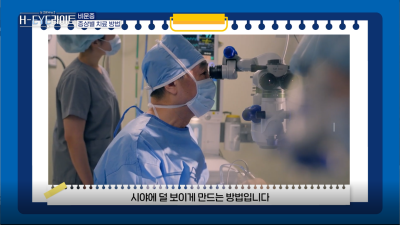
The first option is laser vitreolysis.
This procedure uses a laser to break large floating opacities into tiny fragments, making them less noticeable in your vision.
However, it is not effective in every case,
and there are risks of increasing the number of debris fragments or damaging the retina,
meaning it requires very cautious consultation with an eye specialist.
Eye Floater Treatment 2: Surgical Treatment


The second option is surgical treatment (vitrectomy).
This surgery removes the vitreous gel from inside the eye and replaces it with a clear balanced fluid.
While it reliably eliminates floaters, it carries risks of serious complications such as cataracts or retinal damage,
so it is performed only under very limited circumstances where the clinical benefits far outweigh the discomfort.

Ultimately, the best approach is neuroadaptation (getting used to them).
Our brain is remarkably smart, and over time it naturally learns to tune out these visual disturbances.


However, the situation changes entirely if the floaters are caused by retinal detachment or hemorrhage.
In such instances, the floaters themselves are not the primary problem; preserving your vision is the top priority,
so immediate laser sealing of any tears or surgical intervention must be undertaken.
When floaters appear, a comprehensive eye examination is essential to pinpoint the exact cause.
Are there ways to prevent or manage eye floaters?

Patients frequently ask, "What supplements should I take?" or "How can I prevent them from forming?"
While age-related vitreous degeneration cannot be completely prevented,
you can certainly adopt habits that slow down ocular aging and protect the health of your retina.
Prevention and Care 1: Relieve Eye Fatigue



First and foremost, relieve eye strain immediately.
When using smartphones or computer screens, follow the 20-20-20 rule: every 20 minutes, take a 20-second break
and look at an object at least 6 meters (20 feet) away.
Allowing the eye’s focusing muscles time to relax reduces mechanical stress placed on the vitreous and retina.
Prevention and Care 2: Block Ultraviolet (UV) Rays

Second, ensure proper UV protection whenever you spend time outdoors.
Intense sunlight induces oxidative stress within ocular tissues and accelerates aging,
so getting into the habit of wearing sunglasses or wide-brimmed hats helps protect against floater progression.
Prevention and Care 3: Retinal Nutrition via a Healthy Diet


Third, supply your retina with proper nutrients through a balanced diet.
Consistently eating dark leafy green vegetables like spinach—rich in lutein and zeaxanthin—along with blue-backed oily fish packed with omega-3 fatty acids provides significant support.
Prevention and Care 4: Regular Fundus Examinations



Finally, what we emphasize most of all is receiving regular fundus (dilated eye) exams.
For those experiencing floaters, undergoing a comprehensive checkup about once a year
to document and monitor internal eye changes is the safest and most reliable strategy.
In particular, if you notice a sudden explosion of dozens or hundreds of floaters within a short span,
it is vital to visit an ophthalmology clinic immediately for a dilated fundus exam.
Remember that managing eye floaters is not merely about making the specks vanish;
it is about understanding the changes inside your eyes and maintaining healthy long-term vision habits.
What tests are conducted for eye floaters?

Many people feel intimidated by the idea of an eye exam,
but you can rest easy: evaluating floaters involves absolutely no painful procedures.
To ensure an accurate and swift diagnosis, the evaluation is broadly divided into two steps.
Floater Examination 1: Pupillary Dilation Test

The first step is a dilation exam.
Eye drops are administered to enlarge the pupil, followed by a waiting period of roughly 20 to 30 minutes.
If we think of the inside of the eye as a dark room, widening the pupil is like opening the doorway wide
so the physician can shine a bright light in to inspect every nook and cranny.
Floater Examination 2: Detailed Fundus Examination


The second step is a meticulous fundus exam conducted directly by a retina specialist.
Using specialized lenses and slit-lamp biomicroscopy,
the doctor carefully determines whether there are retinal tears, bleeding, or merely benign vitreous opacities.
When necessary, optical coherence tomography (OCT) may also be performed to view high-resolution cross-sections of the retina.


There is one crucial precaution to keep in mind:
Pupillary dilation lasts for roughly 4 to 5 hours.
During this window, you will experience marked light sensitivity and blurry near vision,
meaning driving yourself home is strictly forbidden.
For your safety, please use public transportation or have a companion accompany you to your appointment.


Ultimately, these examinations do more than confirm floaters—
they represent a crucial opportunity to detect hidden retinal defects before they cause irreparable damage.
Where should you go for an eye floater evaluation?



When floaters appear suddenly, you might feel overwhelmed and unsure of where to seek care.
To put it clearly,
while floaters may simply be an aging phenomenon,
they can also be the initial warning sign of sight-threatening diseases;
therefore, choosing a clinic capable of advanced, specialized testing is of paramount importance.
The subjective symptom of "seeing specks" alone
cannot reveal 100% of what is taking place inside your eye.
Here are the 3 key reasons why choosing the right center matters:
1. Differentiating Pathological Floaters


Roughly 10% of patients presenting with floaters have underlying conditions that require urgent intervention,
such as retinal tears or vitreous hemorrhage.
Missing these can allow the retina to peel away like detached wallpaper—a condition known as retinal detachment—leading to permanent vision loss.
2. Difference in Diagnostic Technology and Expertise

The retina is an ultra-thin neural membrane lining the deepest back wall of the eye.
Detecting microscopic tears or holes thinner than a strand of hair requires not only high-resolution diagnostic equipment,
but also the seasoned clinical expertise of a dedicated retina specialist to interpret subtle findings accurately.
3. Availability of Emergency Treatment Systems

If examination reveals a retinal break or tear,
immediate on-site laser photocoagulation is needed to seal the margins and prevent progression to detachment.
Bouncing between different clinics for diagnosis and treatment risks losing the critical golden window for therapy.
Choosing an eye hospital that can diagnose and treat your ocular conditions rapidly and accurately
is the safest course of action for safeguarding your sight.


In this episode of H-EYE-Light,
we explored one of the most common yet significant warning signs our eyes can give us:
eye floaters.
While most cases represent normal physiological aging,
a sudden surge in floating spots into the dozens or hundreds, or an accompanying shadow obstructing your visual field,
could be your eye sounding an emergency alarm!
Please keep this in mind~
Seeing spots floating before your eyes? Want a clear, easy-to-digest guide to floaters? Check out H-EYE-Light on the Hangil Eye Hospital YouTube Channel
Hangil Eye Hospital Location
Appointments and Inquiries
Frequently Asked Questions
Can eye floaters be cured with eye drops or oral medication?
No, floaters cannot be reversed with medications. Vitreous liquefaction is a natural consequence of aging; for benign floaters, standard clinical practice is to allow the brain time to adapt naturally without medical intervention.
Is everyone eligible for laser treatment or surgery for floaters?
No, these options are considered only in rare cases where floaters severely disrupt daily life. Laser vitreolysis and vitrectomy carry significant risks such as retinal tears or cataracts, so they are performed only when the expected clinical benefit clearly outweighs the potential hazards.
When should I visit an eye clinic immediately for floaters?
You should seek emergency ophthalmologic care if you notice a sudden, massive increase in floaters, flashes of light, or a shadow over your peripheral vision. These symptoms can herald retinal tears, vitreous hemorrhage, or retinal detachment.
Can I drive myself home after a comprehensive floater examination?
No, you must avoid driving on the day of the exam. Dilation eye drops enlarge the pupil for 4 to 5 hours, causing intense glare and blurred close-up vision; please use public transit or arrange for someone to accompany you.
What lifestyle habits help prevent floater progression and maintain eye health?
Resting your eyes with the 20-20-20 rule and wearing UV-blocking sunglasses are very effective. Eating a nutrient-dense diet rich in lutein, zeaxanthin, and omega-3s, alongside scheduling annual dilated fundus examinations, offers the safest long-term protection.