2026-10-24
Who Should Consider SmilePro? Hangil Eye Hospital in Bupyeong
Hangil Eye Hospital in Bupyeong explains who benefits most from SmilePro, including patients at risk of suction loss, those with high astigmatism, and anxious patients.

Hello. This is Hangil Eye Hospital, the only dedicated eye hospital in Incheon.
Many people are torn over whether or not to get SmilePro, right?
Let's take a look at who SmilePro is recommended for together with Dr. Lee Sang-mok of Hangil Eye Hospital in Bupyeong.
1. Are there patients for whom SmilePro is especially recommended?
Patients at risk of suction loss

For SMILE surgery, the laser device must make direct contact with the eye, so the eye is stabilized using a contact glass. To do this, suction is applied to create negative pressure. If the eye moves forcefully or the patient closes their eyes during surgery with a force that overcomes that negative pressure, the fixation is lost. This is called suction loss. If the fixation is lost during laser application, it is possible to try again, but the new cut may not line up with the previously cut section, and the lenticule may not separate cleanly. Because patients who experience suction loss tend to have it again during re-operation, there are times when the surgery has to be finished with LASEK. For this reason, it is best to complete the surgery without suction loss from the start whenever possible.


The main culprit behind suction loss is patient anxiety. During surgery, thoughts like "Am I doing well?", "Is this really the right spot I'm supposed to be looking at?", "Is it okay to keep my eyes open this long?", and "What if my eyes start to ache?" cause the eye to move. Calming these worries and staying as composed as possible is important, but it's not as easy as it sounds. Anxiety tends to grow the longer the laser application lasts, so a short laser time is above all important. Compared with the roughly 25 seconds per eye required for conventional SMILE, SmilePro takes about 10 seconds, which is 2.5 times faster, dramatically shortening the time during which anxiety can build. This is the most important improvement SmilePro offers. When I first heard that the laser time had been cut to under 10 seconds, I was genuinely amazed and wondered, "How is such speed even possible?" If you start a stopwatch on your phone and try to keep your eyes from twitching for 25 seconds, you'll get a sense of how big the difference between 10 and 25 seconds really is. Since anesthesia is used during surgery, it isn't very uncomfortable, but even so, tension and anxiety make the eyes blink more often.
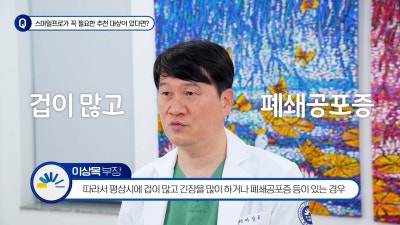
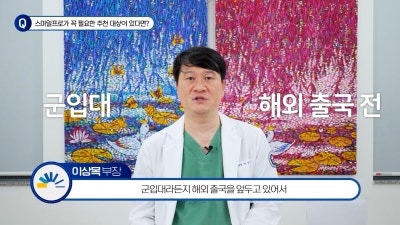
The previous SMILE device, the VisuMax 500, was bulky and gave the feeling of being inside an MRI machine, which could heighten anxiety. In contrast, the newer VisuMax 800, which Hangil Eye Hospital uses for SmilePro, is smaller and doesn't block the patient's view until just before surgery, so it causes much less anxiety. Hangil Eye Hospital in Bupyeong recommends SmilePro for people who are generally timid or very nervous or who have claustrophobia, for those who have difficulty cooperating during pre-surgery exams, and for those about to enlist in the military or travel overseas.
Patients with significant astigmatism

For nearsightedness, you only need to correct the amount of myopia accurately. For astigmatism, however, it's important to get not only the amount right but also the precise angle of the axis. When a person moves from sitting to lying down, the eye can rotate slightly clockwise or counterclockwise, so the astigmatic axis may differ from what was measured while seated. With conventional SMILE, correcting this rotation when lying down could only be done mechanically, by turning the patient's eye while it remained fixed to the contact glass. SmilePro uses a feature called Oculine, which allows astigmatism correction to be performed more stably. Hangil Eye Hospital in Bupyeong recommends SmilePro over conventional SMILE for patients with significant astigmatism, or when the astigmatism is larger than the nearsightedness.
2. What do you see as SmilePro's biggest advantage from the surgeon's perspective?


I believe that being more than 2.5 times faster is, above all, the most important technical advance. Reported suction loss rates range from 0.04% to 6.4%, averaging around 1%, so it isn't very common. However, when there is a risk of suction loss during surgery, and you can see the eye twitching, the surgeon gets just as tense. Even while trying to ease the patient's anxiety with small talk, I sometimes wonder, "Could my own anxiety be unconsciously amplifying the patient's anxiety?" Honestly, it can be a worry. Some patients keep the surgeon on edge throughout the procedure, and there are times when those 25 seconds feel like 10 minutes. From that standpoint, the improvement I would point to as the biggest benefit for surgeons is the faster laser application.

On the technical side, when separating the lenticule after laser application, SmilePro offers less resistance than conventional SMILE, and in some cases the lenticule can be removed simply by pulling it out, with little or no dissection needed. Because there is less physical impact, visual recovery feels a bit faster. Occasionally, a large amount of air bubbles forms during laser application. This is called OBL (Opaque Bubble Layer). When OBL occurs, the bubbles that have already formed spread out and interfere with the next laser pulses, making separation in that area somewhat more difficult. With SmilePro, however, the laser moves faster than the bubbles spread, so OBL is said to cause fewer separation difficulties. So far, I have not experienced any separation difficulties caused by OBL with SmilePro.
The Oculine feature, which corrects the astigmatic axis, and the Central Line feature, which helps avoid errors caused by pupil decentration and keeps the eye's central axis aligned, are also very helpful from the surgeon's standpoint.
Curious about SmilePro? Check out the content below! Lee Sang-mok, Ophthalmologist, Hangil Eye Hospital
✳️ Who should consider SmilePro? If you're torn about whether to get it, read this:
✳️ SmilePro True-or-False Quiz: Good to know!
How to get to Hangil Eye Hospital
Reservations and Inquiries
Frequently Asked Questions
Who is SmilePro recommended for?
Patients at risk of suction loss and patients with significant astigmatism are presented as recommended candidates for SmilePro. Hangil Eye Hospital in Bupyeong also recommends SmilePro for people who are generally timid or very nervous, those with claustrophobia, and those about to enlist in the military or travel overseas.
What is suction loss?
Suction loss is when the contact glass loses its grip on the eye because the eye moves forcefully or the patient closes their eyes during surgery. If the grip is lost, the procedure can be retried, but the new cut may not match the previously cut section, and the lenticule may not separate cleanly. Patients who experience suction loss also tend to have it again during re-operation, so the surgery may need to be finished with LASEK.
How long is the laser application time with SmilePro?
With SmilePro, the laser application time per eye is about 10 seconds. That is 2.5 times faster than the roughly 25 seconds of conventional SMILE. Since anxiety tends to grow the longer the laser runs, a short application time is considered important.
Why is SmilePro recommended for people with significant astigmatism?
Because SmilePro uses the Oculine feature, astigmatism correction can be performed more stably. For astigmatism, not only the amount but also the precise axis angle matters, and the eye can rotate slightly when lying down, which can shift the astigmatic axis.
Does the new SMILE device reduce patient anxiety?
Yes. The newer VisuMax 800 is smaller and doesn't block the patient's view until just before surgery, so it causes much less anxiety than the previous device. The earlier VisuMax 500 was bulky and gave the feeling of being inside an MRI machine, which could heighten anxiety.