2026-10-26
Hangil Eye Hospital SmilePro Q&A Roundup
A SMILE-certified surgeon at Hangil Eye Hospital answers common questions about SmilePro: what the procedure is, why clinics use different names, whether faster laser speed helps, pain, and side effects.



Hello, this is Hangil Eye Hospital, Incheon's only dedicated eye hospital.
Today's topic is 〈SmilePro Q&A Roundup〉.
We collected your questions about SmilePro and asked a SMILE-certified surgeon! What kind of procedure is SmilePro? Is the faster laser speed really a good thing? Does it hurt? Are there any side effects? Let's hear the answers!
What kind of procedure is SmilePro?
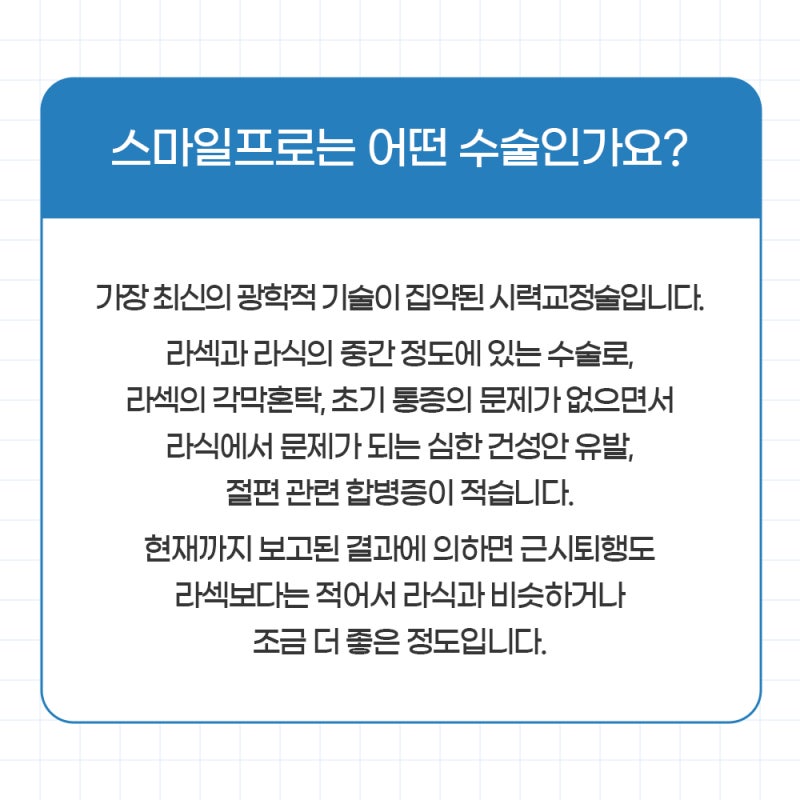
SmilePro is a vision correction procedure that brings together the latest optical technology. It was developed by ZEISS, a company with a 175-year history, and launched in Korea in October 2023 as a new vision correction option.
SMILE is often described as a vision correction procedure that combines the advantages of LASEK and LASIK. It avoids the corneal haze and early pain associated with LASEK, and it also causes fewer severe dry eye problems and flap-related complications, which are concerns with LASIK. The same applies to SmilePro. Reported results so far show that myopic regression is also lower than with LASEK, comparable to or slightly better than LASIK.
Why do hospitals use different names, such as SMILE, CLEAR, SMART, and SILK?


SMILE stands for Small Incision Lenticule Extraction.
It is a term created by ZEISS to describe the surgical method of removing the lenticule through a small incision.
ZEISS developed the VisuMax 500 and launched SMILE, and for more than a decade afterward, it had this field almost entirely to itself with no competitors. As a result, the name SMILE has become both ZEISS's registered trademark and a common name for the lenticule extraction method through a small incision. You've probably heard of SMILE, but names like CLEAR, SMART, and SILK may sound less familiar. Similar vision correction methods have emerged recently, but since SMILE is already a registered trademark, they use different names. Usually, names like CLEAR, SMART, and SILK depend on the vision correction equipment used.
Is the faster laser speed really a major advantage?

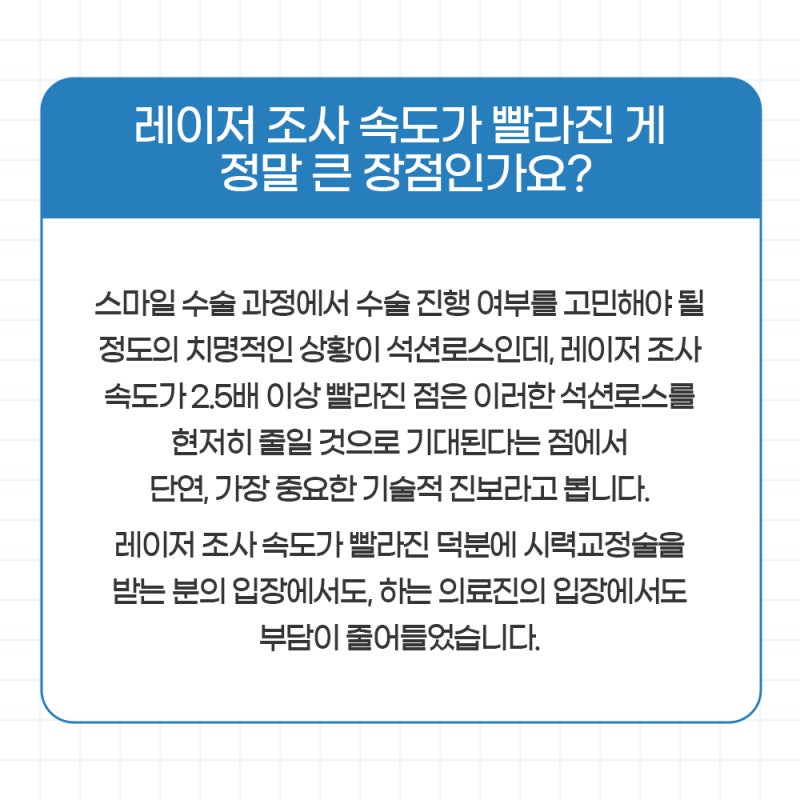
Vision correction surgery requires minimizing eye movement. To make this possible, patients wear a lid speculum (a device that stabilizes the eye), and the equipment itself also runs an eye-fixation system. Before surgery, patients are told to fix their gaze on a single point (usually a green light) and not move their eyes. Many people find this stressful.
When the eye-fixation system loosens, it is called suction loss. The laser delivery speed, now 2.5 times faster than before, is expected to significantly reduce the rate of suction loss. Previously, patients had to hold still for about 25 seconds, but now it's only about 10 seconds.
Does SmilePro hurt?


For anyone considering vision correction surgery, this is one of the most important questions: pain!
The surgeon who answered this question says they ask patients after vision correction surgery whether it hurt. So far, no one has said it was painful.
That said, topical anesthetic eye drops are used for SmilePro and other vision correction procedures. Very rarely, patients with reduced sensitivity to these drops have reported mild discomfort. If you feel any discomfort during surgery, please tell the surgeon. Additional anesthetic drops can be given so you can complete the procedure without discomfort.
Does SmilePro have side effects?

Another question you're probably most curious about: side effects!
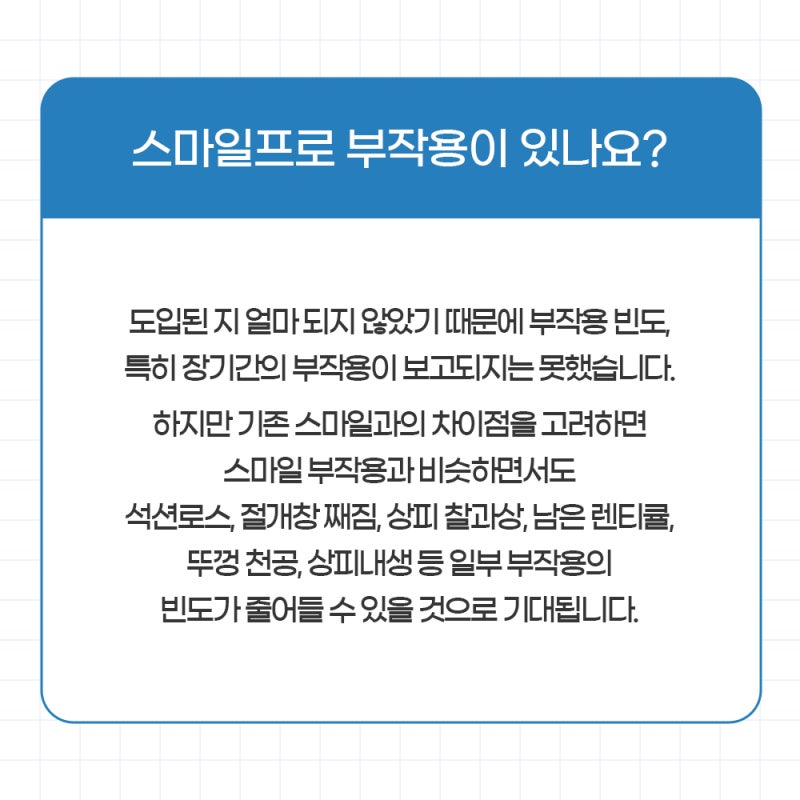
Because SmilePro was introduced only recently, the frequency of side effects, especially long-term ones, has not been sufficiently reported.
However, considering the differences from the existing SMILE, the frequency of some side effects, such as suction loss, incision tearing, epithelial abrasion, residual lenticule, cap perforation, and epithelial ingrowth, is expected to decrease, while the procedure remains similar to the existing SMILE.
Consultation: SMILE Doctor Lee Sang-mok, Head of Research, Hangil Eye Hospital

We gathered questions about SmilePro and asked Head of Research Lee Sang-mok at Hangil Eye Hospital to answer them.
We hope this helps answer some of your questions. 💙

Frequently Asked Questions
What kind of procedure is SmilePro?
SmilePro is a vision correction procedure that brings together the latest optical technology. Developed by ZEISS and introduced in Korea in October 2023, it is described as a method that combines the advantages of LASEK and LASIK.
Why do hospitals use different names?
Names usually depend on the vision correction equipment used, and SMILE is a ZEISS registered trademark. SMILE refers to the method of removing the lenticule through a small incision. Since similar methods have emerged recently and the already-registered name SMILE cannot be used, names such as CLEAR, SMART, and SILK are used instead.
Is the faster laser speed a major advantage?
The surgeon said the faster speed is expected to significantly reduce the rate of suction loss. Suction loss is when the system holding the eye in place loosens. Thanks to a laser delivery speed 2.5 times faster than before, the time patients need to hold still has been reduced from about 25 seconds to about 10 seconds.
Does SmilePro hurt?
According to the surgeon who answered, no patient has said they were in pain after surgery. However, very rarely, some patients with reduced sensitivity to the topical anesthetic have reported mild discomfort. If you feel uncomfortable during surgery, you can tell the surgeon, and additional anesthetic drops can allow you to undergo the procedure without discomfort.
Does SmilePro have side effects?
SmilePro was introduced only recently, so the frequency of side effects has not been sufficiently reported. It is similar to the existing SMILE, but the frequency of some side effects, such as suction loss, incision tearing, epithelial abrasion, residual lenticule, cap perforation, and epithelial ingrowth, is expected to decrease.